
 By admin
 Ever wondered why some digital videos seem so real while others don’t? As tech gets better, the difference between simple clips and high-quality ones gets smaller. But, making true visual perfection is still a big challenge for developers.
The field has moved from simple tests to complex models needing lots of power. To get closer to reality, creators focus on native resolution. When you watch ai celebrity porn 4k, the sharpness of each pixel matters a lot. Without it, even the best algorithms find it hard to make faces and bodies look natural.
Knowing these tech basics helps you see how hard it is to make digital media look real. High-definition isn’t just a fancy feature; it’s the main challenge for those trying to make seamless, lifelike content in this competitive field.
Key Takeaways
- Native resolution is key for realistic human textures.
- As visual quality goes up, the need for computing power grows.
- Early viral models didn’t have the depth needed for HD.
- Creating realistic human features is still the biggest challenge for software.
- High-definition standards are crucial to close the digital realism gap.
Understanding the Role of Resolution in AI Generation
The secret to high-end AI content is knowing the difference between native resolution and software-based upscaling. The base resolution sets how much info is used for the final image. Native 4K output gives a huge canvas for detailed work that lower resolutions can’t match.
The Difference Between Upscaling and Native 4K
Many creators use upscaling tools to make smaller images bigger. These tools are good but can make images look soft or artificial. Native 4K generation, on the other hand, uses the full pixel count from the start.
Using native resolution keeps textures and edges sharp and real. This is the gold standard for top-quality projects. It helps your AI models work better without losing quality.
Why Pixel Density Defines Hollywood Realism
To get hollywood realism, you need more data than just software tools. Pixel density tricks the eye into seeing digital images as real. High pixel density lets AI render fine details and textures well.
Choosing high-density source material gets you closer to professional cinema standards. This focus on quality keeps your output looking realistic on big screens. The quality of your input data is key to a professional look in your final images.
Hardware Requirements for High-Fidelity AI Rendering
To handle big data loads in high-resolution AI projects, you need the right hardware. Getting 4K output isn’t just about software settings. It also needs a machine that can handle gpu rendering well.
Computational costs for high-quality video are still high. Your hardware choices are key to your project’s success and how accessible it is.
Selecting the Right GPU for 4K Workflows
The graphics processing unit is the heart of your production pipeline. For 4K resolutions, you need a card that balances speed and memory. Investing in professional-grade hardware keeps your training sessions efficient and stable.
Choose cards with high CUDA core counts for parallel processing tasks. A strong gpu rendering setup cuts down training time. Without the right power, you might face system crashes during long training cycles.
Managing VRAM Constraints During Deepfake Training
Video RAM (VRAM) is often the main challenge with 4K datasets. High-resolution frames use memory fast, leaving little for complex facial features. Keep an eye on memory usage to avoid “out of memory” errors.
To handle VRAM limits, try reducing batch sizes or use gradient checkpointing. These methods help keep high visual quality even when hardware is pushed hard. Good gpu rendering balances these technical choices well.
| GPU Tier | VRAM Capacity | 4K Performance | Best Use Case |
|---|---|---|---|
| Entry Level | 8GB – 10GB | Limited | Experimental testing |
| Mid-Range | 12GB – 16GB | Moderate | Standard 4K projects |
| High-End | 24GB+ | Excellent | Professional production |
Step One: Preparing Your Source Material for 4K Output
Your final output is only as good as the raw data you feed into your model. When aiming for top-notch results, the preparation phase is the most critical step. Skipping this stage can lead to blurry textures and uneven facial features in your final renders.
“Quality is never an accident; it is always the result of high intention, sincere effort, intelligent direction and skillful execution.”
To get the best results, focus on the quality of your input files. High-resolution source material is key for ai celebrity porn 4k generation. It ensures the AI can recreate detailed skin textures and complex lighting patterns.
Sourcing High-Resolution Training Data
Finding the right source material needs a strategic approach. Look for footage with consistent lighting and clear views of the subject’s face. High-definition video is best, as it lets the model learn fine details that lower-quality clips can’t.
When gathering your assets, keep these factors in mind to ensure a strong dataset:
- Resolution: Always aim for native 1080p or higher to avoid upscaling issues.
- Variety: Include different angles, expressions, and lighting conditions to improve model versatility.
- Clarity: Avoid footage with heavy compression or motion blur, as these degrade the final ai celebrity porn 4k output.
Cleaning and Normalizing Datasets for AI Celebrity Porn 4K
After collecting your raw files, clean and normalize them for consistency. Remove frames where the subject is obscured or the lighting is too harsh. Standardizing your dataset reduces errors during training.
Normalization ensures the AI interprets the data uniformly, which is key for sharpness. Proper preparation of your ai celebrity porn 4k dataset lets the model focus on learning facial structures. This saves you from troubleshooting later.
Step Two: Configuring Your AI Model for High-Resolution Training
Getting your AI setup right is what makes the difference between blurry images and crisp, professional-grade imagery. For high-resolution output, your model needs a detailed approach to data processing. This ensures your AI models reach their limits while keeping images clear.
Adjusting Latent Space Parameters
The latent space is a compressed version of your training data. To capture intricate fine details for high-resolution output, tweak these parameters carefully. Increasing the latent space dimension helps the model store more complex features, crucial for realistic skin and facial expressions.
But, don’t set these values too high, as it can cause overfitting or noise. Finding the right balance is essential for your model to learn the subject’s structure, not just memorize images. Adjusting these settings will help you achieve the clarity needed for top-quality projects.
Optimizing Batch Sizes for 4k AI Porn Projects
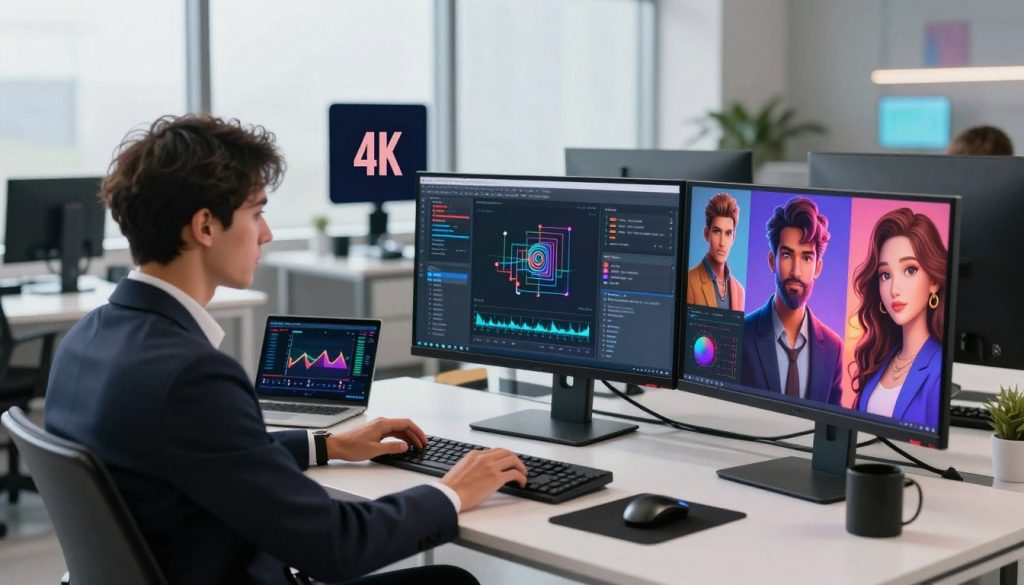
Managing your hardware well is crucial for 4k ai porn projects. The batch size shows how many images the model processes before updating its weights. A bigger batch size speeds up training but uses more VRAM, risking system crashes if it exceeds your GPU’s limit.
For high-resolution training, memory stability is more important than speed. If you hit out-of-memory errors, try reducing the batch size and use gradient accumulation. This method lets you work with larger batches without overloading your hardware, keeping your 4k ai porn workflow smooth and efficient.
The Impact of GPU Rendering on Texture and Skin Detail
When aiming for 4K resolution, how your system handles skin detail is key. To get lifelike results, you need more than just high-resolution files. You also need advanced gpu rendering techniques.
Without the right optimization, your work might look flat or fake. It won’t capture the small details that make human skin look real.
Simulating Subsurface Scattering for Realistic Skin
Subsurface scattering is when light goes through a surface, scatters, and comes out somewhere else. In digital art, this is crucial to avoid a fake look. Advanced gpu rendering helps mimic this process, giving skin a natural glow.
Adjusting shader settings is important. It lets light penetrate deeper in areas like the ears and nose. This makes your renders look more natural and detailed.
Maintaining Facial Consistency at Higher Resolutions
Scaling up to 4K makes keeping facial features consistent a big challenge. As pixels get denser, AI models might not map them right, causing identity shifts. It’s vital to keep your training data perfectly aligned during gpu rendering to avoid these issues.
Using top-notch reference frames helps the AI model place facial landmarks better. This is essential for keeping your subject’s identity clear in every frame. Here’s how different rendering settings affect your final quality.
| Setting | Low Quality | High Quality |
|---|---|---|
| Texture Depth | Flat/Blurry | Detailed/Porous |
| Light Scattering | None | Subsurface |
| Facial Stability | High Variance | High Precision |
| Render Time | Fast | Extended |
Overcoming Artifacting and Blurring in AI Content
To master 4k ai porn production, you must first learn to fix common visual errors. Artifacting and blurring happen when the source material lacks detail for high-resolution upscaling. These issues can ruin your project if not fixed early.
Identifying Common Upscaling Errors
Upscaling errors often come from insufficient training data or aggressive compression. When the source material is too small, the AI model can’t add missing details. This leads to “smearing” or blocky artifacts. Skin textures may look waxy, and edges jagged instead of smooth.
Another problem is when the model’s native resolution doesn’t match the target output. Forcing a low-resolution model to create 4K content introduces noise. Finding these bottlenecks is crucial for achieving a professional look in your 4k ai porn projects.
Techniques to Preserve Sharpness in Final Renders
To keep your content clear, use high-quality source datasets close to your target resolution. Applying sharpening filters in post-processing can help, but do it carefully to avoid digital grain. It’s better to refine your latent space parameters during training than to fix it later.
Consistency is key for crisp final renders. Normalizing your training data and using advanced upscaling models can reduce manual cleanup needs. The table below shows common visual issues and how to fix them.
| Visual Error | Primary Cause | Recommended Fix |
|---|---|---|
| Waxy Skin Texture | Over-smoothing | Reduce denoising strength |
| Jagged Edges | Low-res source | Use high-quality upscalers |
| Digital Noise | High compression | Use lossless source files |
| Blurry 4k ai porn | Model mismatch | Retrain with higher resolution |
Optimizing Lighting and Color Grading for 4K Realism
Lighting and color grading are key to making synthetic pixels look real. They help turn your AI-generated content into a believable scene. To achieve hollywood realism, you need to carefully control how light interacts with your subject.
Matching Ambient Lighting to Source Footage
To make your content blend seamlessly, study the ambient light in your source footage. Identify the main light source and its color temperature. If your video has warm tones, your AI model should match those chromatic characteristics for consistency.
Use reference frames to get the exact colors of shadows and highlights. Apply these colors in your post-processing to create a seamless look. This step is crucial for placing your subject in the digital world.
“The difference between a amateur render and a professional masterpiece often lies in the subtle manipulation of light and shadow to create depth.”
Color Correction Strategies for Professional Results
Professional color correction is key to hollywood realism in high-end productions. Start by neutralizing your footage with a white balance tool to make skin tones look natural. Then, apply a gentle color grade to match the project’s overall look.
The table below shows the essential adjustments for professional 4K AI projects:
| Adjustment Type | Primary Goal | Impact on Realism |
|---|---|---|
| White Balance | Neutralize color casts | High |
| Contrast Curves | Enhance depth | Medium |
| Saturation Levels | Balance skin tones | High |
| Color Grading | Apply cinematic look | Medium |
By focusing on these adjustments, your final render will have a consistent look. Consistent color grading is crucial for cinematic excellence. Mastering these techniques will help your work reach the hollywood realism needed for professional visual storytelling.
Managing Processing Times and Thermal Throttling
High-load rendering needs careful planning for hardware upkeep and cooling. When you push your system hard, cooling becomes key. Without it, your gpu rendering slows down a lot.
Cooling Solutions for Sustained High-Load Rendering
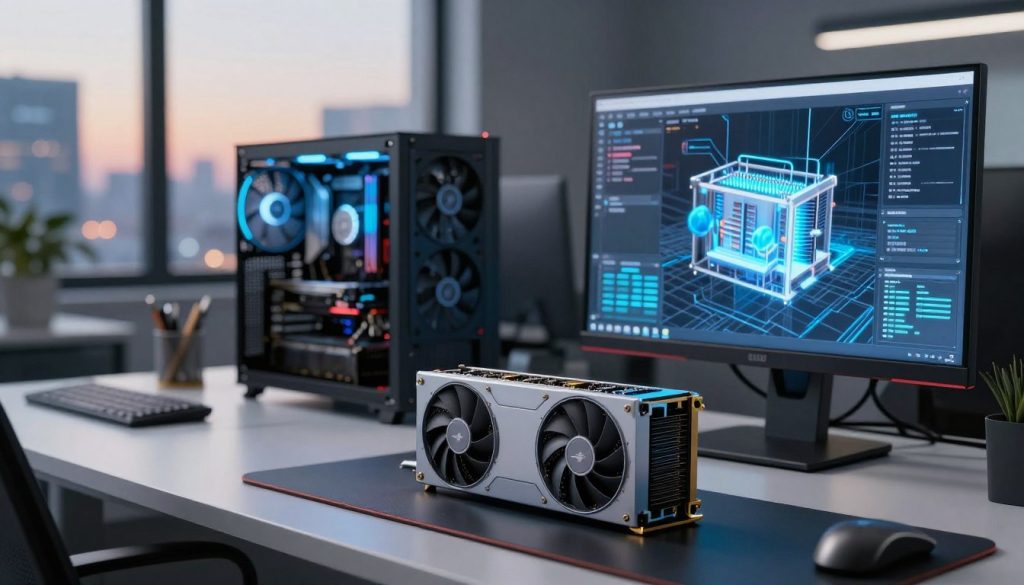
Invest in strong cooling to keep your system running well. Top-notch workstations often use liquid cooling loops. These systems pull heat away better than air fans.
Make sure your case has good airflow. This stops hot air from getting stuck inside. Watch your component temperatures closely during long sessions. Use software to track heat and adjust fan settings.
Keeping cool prevents throttling and extends the lifespan of your gear.
Balancing Render Speed Against Quality Requirements
Finding the right balance between speed and quality is crucial. You might want to crank up all settings, but it’s not always best. It can lead to too much heat and not enough quality.
Adjusting batch sizes helps keep your gpu rendering steady without overloading. Think about your project’s needs before long render times. Sometimes, a small change in settings can cut down time without losing cinematic quality.
Optimizing your workflow for your hardware ensures a smooth 4K production process.
Software Tools and Frameworks for Advanced AI Generation
Choosing the right software is key for top-notch digital work. For 4k ai porn, the tools you pick affect the final quality. Big names like OpenAI and Google have poured resources into making videos better. This guides creators to improve their work.
Comparing Popular Deepfake Software Suites
The market has many strong suites for detailed face swaps. DeepFaceLab leads because it offers detailed control. It lets you use your hardware to the fullest for top results.
FaceSwap is easier to use, perfect for those who want a simple process. Both are key for 4k ai porn. Your choice depends on whether you like command-line or graphical interfaces.
| Software Suite | Ease of Use | Customization | Performance |
|---|---|---|---|
| DeepFaceLab | Moderate | Very High | Excellent |
| FaceSwap | High | Moderate | Good |
| Custom Python Scripts | Low | Maximum | Variable |
Utilizing Open-Source Libraries for Enhanced Detail
Using open-source libraries can really improve your project’s look. PyTorch and TensorFlow are crucial for AI models. They help you add special effects for 4k ai porn.
These tools help you fine-tune your project’s details. Staying ahead means always trying new things. Mixing these frameworks with your software can solve common problems.
Post-Processing Techniques to Enhance Visual Fidelity
Post-processing is key to turning raw AI output into a polished, professional piece. Even with great source material, the final look often needs fine-tuning. By focusing on these final steps, your 4K output will shine with exceptional clarity and depth.
Applying Sharpening Filters Without Introducing Noise
Sharpening aims to make edges clearer without adding digital noise. Too much sharpening can make your image look unnatural and gritty. Use high-pass filters or sharpening masks to focus on edges only.
Check your work at 100% zoom to spot noise. If grain shows up in flat areas, cut back on sharpening. Keeping your image clean is more crucial than extreme sharpness.
Color Grading for Cinematic Hollywood Realism
Color grading is what turns a standard render into professional media. To achieve hollywood realism, balance shadows, midtones, and highlights. A professional color wheel helps adjust the color temperature to fit your scene’s mood.
Adding a subtle film grain can make your image look more organic. This blends AI elements with the background, creating a unified look. By perfecting these color tweaks, you get closer to the cinematic hollywood realism viewers love in high-end films.
Troubleshooting Common Issues in High-Resolution AI Projects
Even with top-notch equipment, you’ll hit technical roadblocks. Learning how to fix these problems is essential for keeping your 4k ai porn quality high.
When errors pop up, a methodical approach helps find the problem fast. This way, your work stays professional and looks great.
Fixing Flickering and Temporal Instability
Flickering happens when AI models can’t keep frames consistent. This is a big deal in high-def videos, where small changes are huge.
To solve this, use temporal smoothing filters later on. These tools smooth out frame transitions by analyzing motion between them.
Also, try lowering the learning rate in the last training stages. This helps the model stabilize, making your 4k ai porn smoother.
Addressing Alignment Issues in 4K Datasets
Alignment problems cause weird facial movements or distorted features. If your images aren’t perfectly aligned, AI can’t match them well.
Make sure your landmark detection is spot-on for every image. Automated tools are helpful, but checking by hand is best for top quality.
If alignment issues keep happening, try cropping your images tighter. Keeping your dataset clean and consistent is key for smooth playback in your 4k ai porn.
Conclusion
To achieve native 4K resolution, you need to focus on technical details and hardware setup. Now, you have the basics to make your AI projects look like they’re straight from Hollywood. Every small detail will be captured perfectly.
Your path includes handling complex GPU tasks and managing datasets carefully. Improve your latent space parameters and enhance post-processing to get top-notch results. This journey to hollywood realism takes time and patience, especially with deepfake tech’s fast changes.
Keep trying new things to find your unique style. Try out different libraries and cooling methods to keep your system stable during long renders. With regular practice, you’ll get better at fixing common problems.
Keep up with the newest in neural network training. Today’s tools let you control visuals like never before. Use these methods in your next project and see your digital work come to life in stunning clarity.
FAQ
Why is native 4K resolution superior to AI upscaling for realistic content?
Native 4K means every frame is made with real detail from the start. This gives you the sharpness needed for true Hollywood quality. AI upscaling tries to guess details, but native 4K captures textures and edges that look real.
What are the minimum GPU requirements for high-fidelity 4K AI rendering?
For 4K output, you need strong hardware like the NVIDIA GeForce RTX 4090 or RTX 6000 Ada Generation. These cards have enough VRAM to handle big datasets without slowing down.
How can I prevent my hardware from overheating during intensive 4K training sessions?
Rendering 4K creates a lot of heat, which can slow down your system. Use top-notch cooling solutions from Noctua or Corsair. Make sure your workstation has good airflow to keep render speeds steady.
What role does subsurface scattering play in achieving Hollywood realism?
Subsurface scattering makes skin look natural by simulating how light interacts with it. With advanced GPU settings, your AI subjects will look more realistic, not plastic.
Which software tools are best for managing high-resolution AI deepfakes?
DeepFaceLab is great for high-resolution projects because it offers detailed control. Other tools like FaceSwap or libraries built on PyTorch and TensorFlow help you achieve detailed 4K AI porn.
How do VRAM constraints impact the quality of the final 4K render?
VRAM is your GPU’s workspace. Without enough, you can’t process high-resolution textures for 4K. Managing VRAM means optimizing settings to keep quality high while rendering efficiently.
What are the most common causes of flickering in 4K AI-generated videos?
Flickering usually comes from unstable or poorly aligned datasets. Clean and normalize your source material with FFmpeg. Then, use filters to smooth out frame transitions for a smooth video.
How important is source material quality when aiming for 4K AI porn production?
Your output’s quality depends on your input. For Hollywood realism, use high-definition training data. Low-quality images will blur and cause artifacts in your 4K model.