
 By admin
Ever thought if your computer could make the world around you look just like it does in real life? Now, turning simple data into detailed pictures is possible.
In 2016, the Apple Neural Scene Analyzer (ANSA) was a pioneering step in analyzing scenes on computers. This innovation is the base of how we handle complex scenes today.
Today, we use the celebrity ai neural engine as the main tool for creating scenes. It lets you learn how to make entire scenes from scratch.
If you’re into coding or digital art, knowing this tech is key. The celebrity ai neural engine gives you the power to make simple inputs into detailed, real-like experiences.
Key Takeaways
- The Apple Neural Scene Analyzer pioneered client-side scene processing in 2016.
- Multi-layer architectures allow for the reconstruction of complex visual environments.
- Modern synthetic generation uses advanced frameworks to ensure high-fidelity outputs.
- You can transform raw data into detailed digital scenes using these tools.
- Mastering these systems is vital for creating immersive digital projects today.
Understanding the Foundations of Scene Reconstruction
Scene reconstruction has changed a lot. It’s now fast and automated, thanks to neural networks. This change lets us capture the real world’s complexity with great accuracy. It’s a big shift in how we create digital spaces.
The Evolution of Synthetic Environment Generation
Creating virtual spaces used to take a lot of time and effort. Artists had to draw every detail by hand. This made the results stiff and unalive.
Now, we use data-driven methods for better results. Tools like the Apple Neural Scene Analyzer (ANSA) are leading this change. ANSA makes complex scenes easier to manage. It keeps your scene reconstruction top-notch from start to finish.
Core Principles of Multi-Layer Neural Networks
Multi-layer neural networks are key to these advances. They process lots of visual data to find patterns and depths. This mix of deep learning and physical knowledge lets us create realistic models.
“The true power of neural architecture lies not in the data itself, but in the ability of the network to infer the hidden geometry of the world from limited observations.”
To see how these methods compare, let’s look at some technical approaches:
| Methodology | Efficiency | Realism Level | Automation |
|---|---|---|---|
| Manual Modeling | Low | Moderate | None |
| Photogrammetry | Medium | High | Partial |
| Neural Scene Reconstruction | High | Very High | Full |
As you improve your scene reconstruction skills, aim to connect raw data with human perception. Using neural network basics, you can make your synthetic environments truly professional.
Preparing Your Data for the Celebrity AI Neural Engine
Success in synthetic scene generation starts with good data preparation. To master the celebrity ai neural engine, you need to know how to prepare your data right. Doing this well helps avoid common problems and makes sure your model learns well from the data you give it.
Sourcing High-Fidelity Source Material
The quality of your output depends on the quality of your input. When getting material for the celebrity ai neural engine, choose high-resolution assets. These should have fine details and show different lighting conditions. Low-quality or compressed media can cause problems in the final output.
To create a good dataset, keep these points in mind:
- Resolution: Go for 4K or higher to catch small textures.
- Diversity: Include many angles and settings to help the model learn more.
- Consistency: Use the same color profiles to avoid flickering in the output.
Preprocessing Techniques for Neural Compatibility
After getting your assets, you need to make them ready for the system. Big datasets need parallel training on many GPUs to handle them. Use special techniques to make memory use better and speed up learning.
Here are some steps to make your data work well with the system:
- Gradient Checkpointing: This method saves memory by using storage instead of compute during backpropagation.
- Mixed-Precision Training: Using lower-precision math boosts speed without losing accuracy.
- Resizing and Sharding: Make sure all inputs are the same size and split big files into smaller parts to avoid loading problems.
These steps are key for the celebrity ai neural engine to work its best. By managing your data well, you set up a strong base for complex tasks. Good data handling means your hardware is used well during training.
Mapping the Hollywood Set Environment
To create a believable digital world, you need to master mapping a real hollywood set. This step is key to making your digital scenes match the real world perfectly. Without this, your final product might feel off or look wrong to viewers.
Spatial Analysis and Depth Estimation
Getting the exact distance between objects in your scene is crucial. Use LiDAR scanning or photogrammetry to get the environment’s exact shape. These methods help you create a 3D model that’s the base for your digital scene.
“Precision is not just a technical requirement; it is the bridge between a flat image and a living, breathing environment.”
After getting your 3D model, you need to figure out the scene’s depth. This means identifying what’s in the front, middle, and back. This helps the AI know how to place objects correctly, making the scene feel real.
Lighting and Texture Calibration
Next, work on the scene’s look. Lighting needs to match the original footage’s light intensity and color. Make sure your digital lighting looks natural by normalizing these values.
Texture mapping is also important. You need high-quality textures to keep the scene looking real. If your textures don’t match the real objects, your scene won’t look right. Balancing these elements ensures your digital world stays believable.
Configuring the Celebrity AI Neural Engine
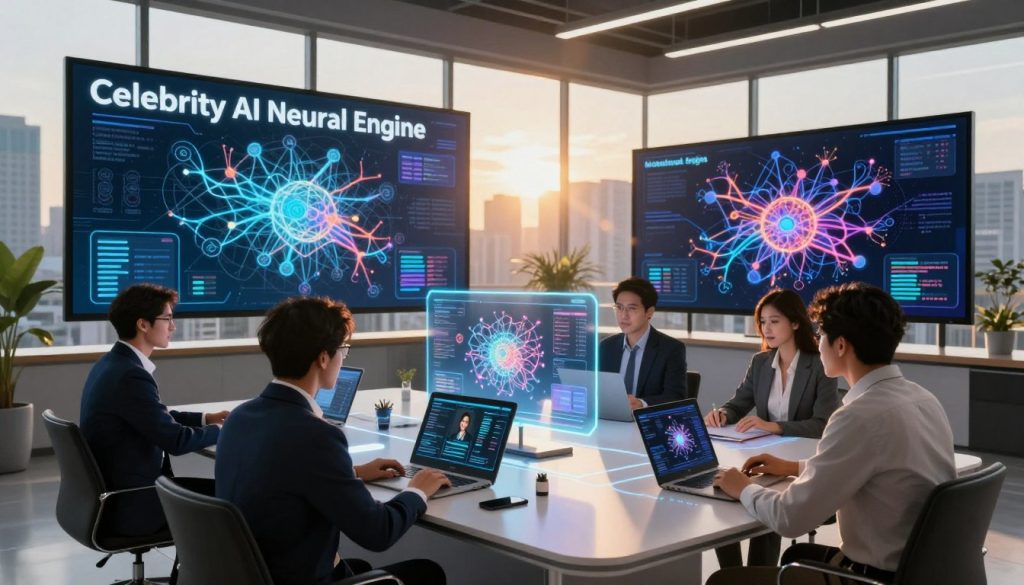
Setting up the celebrity ai neural engine right turns raw data into clear, detailed scenes. When you get it right, your system works well with complex frames. This is key for top-notch visuals in your work.
Setting Hyperparameters for Scene Stability
Stability comes from fine-tuning your settings. The ANSA architecture is a big help here. It has 16 million parameters for fast processing. This lets you work on all parts of a scene in under 9.7 milliseconds, using just 24.6 MB of memory.
Focus on these settings to avoid problems during scene building. A good balance in your settings helps the celebrity ai neural engine handle detailed textures well. Always test your settings on small parts before a big render.
Optimizing GPU Resources for Complex Rendering
Managing resources well is key for high-res scenes. By using your GPU for certain tasks, you cut down on wait times. This lets you make creative changes without delays.
The table below shows how optimized settings improve the celebrity ai neural engine:
| Metric | Standard Mode | Optimized Mode |
|---|---|---|
| Memory Usage | 48.2 MB | 24.6 MB |
| Execution Speed | 18.4 ms | 9.7 ms |
| Stability Rating | Moderate | High |
| Rendering Load | Heavy | Balanced |
Using these optimization strategies helps you control your hardware better. This balance ensures your scenes are sharp and professional. Keeping an eye on your GPU helps keep your project running smoothly.
Layering Neural Architectures for Depth
To achieve top-notch visual depth, you need a smart way to layer your neural architectures. Breaking down a scene into parts lets you control the final look and lighting. This method is key to advanced rendering, treating each part as its own thing in the digital world.
Isolating layers stops visual clutter where textures mix too much. This keeps your image sharp and clear on every level. Precision is the key to a story that feels real and pulls you in.
Foreground Subject Integration
The foreground subject grabs your attention. It needs lots of processing to stay sharp against the scene. By using a special neural layer, you can sharpen and light the subject without messing up the background.
“The essence of a great scene lies in the separation of elements, where each layer tells a part of the story while contributing to the whole.”
Working on the subject alone lets you fine-tune details like edges and depth of field. You can tweak contrast and color to make it stand out. This attention to meticulous detail makes your work stand out from amateur efforts.
Background Environment Synthesis
After focusing on the subject, you can work on the background. This layer adds context and scale to your scene. By making the background separately, you keep the scene’s perspective and lighting consistent.
Use global illumination parameters to blend the background with the subject. This avoids the “floating” look that happens when layers don’t match. A well-done background adds depth and makes your scene feel real and three-dimensional.
Managing Neural Engine AI Porn and Synthetic Content Ethics
Creating realistic synthetic content comes with big responsibilities. You must think about the impact your work has online. Ethical decision-making is key for any serious creator.
Navigating Content Safety Guidelines
Industry standards are always changing to keep up with synthetic media. You need to know the latest rules to keep your work safe and legal. This is crucial for topics like neural engine ai porn or other non-consensual images.
“With great power comes great responsibility. The tools we build today define the digital ethics of tomorrow.”
Always check the terms of service for your tools and platforms. Many have strict rules against harmful or explicit content. Following these rules helps keep your reputation safe and the online world safer.
Responsible Use of Synthetic Media Tools
To keep trust and integrity online, you need to be proactive. Create a personal guide for checking your neural engine’s output. If a project might be unethical, like neural engine ai porn, change your plan.
Being open about your work is important. When you share synthetic media, tell your audience what it is. This helps them understand the difference between real and fake, promoting honesty and mutual respect.
Your choices shape the future of this field. By focusing on ethics, your work will add value, not harm. Use your skills to innovate, always keeping the human aspect in mind.
Executing the Initial Scene Reconstruction
The moment of truth arrives when you trigger the initial reconstruction of your digital environment. This phase marks the transition from raw data preparation to the actual generation of your synthetic world. By utilizing the celebrity ai neural engine, you can begin to see your creative vision take shape in a virtual space.
Running the Primary Neural Pass
To start, you must initiate the primary neural pass within your software interface. This process instructs the system to synthesize the spatial data and textures you have previously mapped. Patience is essential during this stage, as the engine performs complex calculations to align your assets correctly.
Once the process begins, the software will generate a preliminary version of your environment. This initial scene reconstruction serves as a baseline for all future refinements. You should monitor the progress bar closely to ensure that the system allocates enough memory to handle the high-fidelity requirements of your project.
Identifying Artifacts and Rendering Errors
After the first pass completes, your primary goal is to inspect the output for any visual inconsistencies. It is common to encounter minor artifacts or rendering errors during this early stage of scene reconstruction. Detecting these issues immediately allows you to troubleshoot effectively before you commit to more intensive rendering tasks.
Look for common problems such as flickering textures, misaligned geometry, or unexpected lighting gaps. Using the celebrity ai neural engine effectively requires an iterative approach where you constantly review and adjust your parameters. By catching these errors early, you ensure that your final output remains polished, professional, and visually stunning.
Refining Textures and Lighting Consistency
The difference between a standard render and a professional-grade production often lies in the final polish of your lighting and textures. Achieving true visual fidelity requires a deep dive into these final stages of scene reconstruction. By focusing on these elements, you ensure that your synthetic environment interacts with light in a physically plausible manner.
Applying Neural Style Transfer for Realism
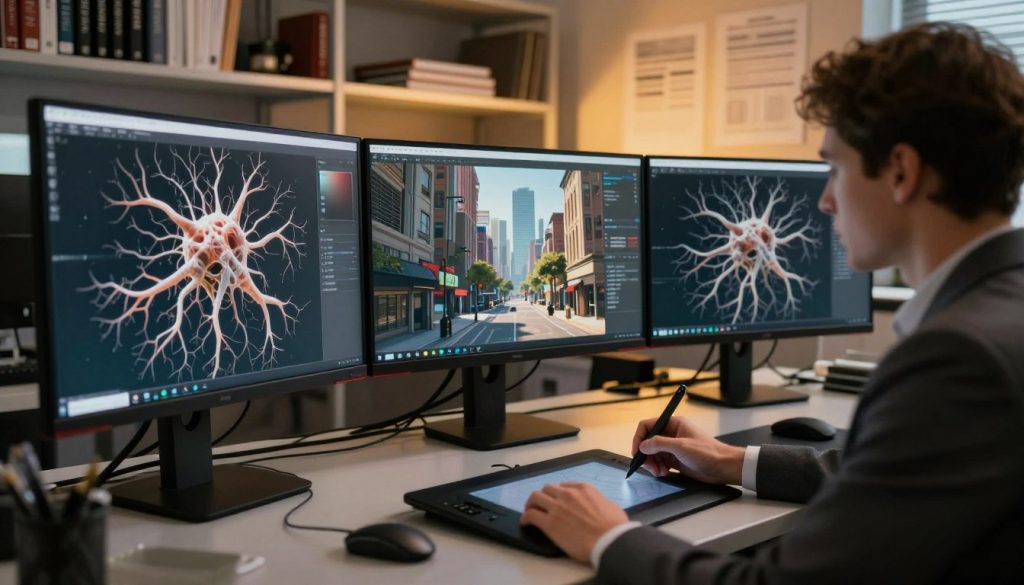
Neural style transfer acts as a powerful tool to bridge the gap between raw synthetic data and high-end visual output. By applying specific artistic or photographic styles to your textures, you can enhance the surface detail and depth of your scene. This process helps mask minor imperfections that often occur during the initial reconstruction phase.
When you implement this technique, focus on maintaining the integrity of your original geometry. You want the style transfer to complement the existing structure rather than overwhelm it. Consistency is key to ensuring that every object in your scene feels like it belongs to the same physical space.
Adjusting Global Illumination Parameters
Global illumination is the engine that drives the realism of your lighting environment. You must carefully calibrate these parameters to simulate how light bounces off surfaces and interacts with the surrounding atmosphere. Properly configured light paths prevent your scene from looking flat or artificial.
Adjusting these settings allows you to control shadows, highlights, and color bleeding between objects. When you achieve the right balance, your synthetic environment will exhibit a natural look that mimics real-world physics. Use the following table to guide your adjustments for different types of environments.
| Environment Type | Lighting Intensity | Bounce Count | Texture Sharpness |
|---|---|---|---|
| Indoor Studio | High | 3 | Ultra-High |
| Outdoor Daylight | Medium | 5 | High |
| Low-Light Night | Low | 8 | Medium |
| Abstract Space | Variable | 2 | Soft |
Advanced Techniques for Dynamic Scene Movement
Dynamic scene movement is key to turning digital images into a real movie feel. It’s not just about static pictures. Neural rendering mixes deep learning with computer graphics to control scenes.
Temporal Consistency Across Frames
Keeping frames consistent is a big challenge in synthetic video. If not done right, your video might look jerky. This is because each frame is seen as separate, not part of a flow.
To fix this, use algorithms that track pixel movement over time. This keeps lighting and texture steady. It’s crucial for making synthetic media that looks real.
Motion Blur and Camera Path Integration
Motion blur is key for a real movie look. Cameras capture light briefly, causing a blur on fast objects. Adjusting your shutter speed parameters in the neural engine can mimic this.
Also, precise camera paths make your work look better. Smooth paths avoid the stiff movements seen in basic renderings. Here’s a table showing the main differences between these techniques:
| Technique | Primary Benefit | Implementation Focus |
|---|---|---|
| Temporal Smoothing | Eliminates flickering | Frame-to-frame weight anchoring |
| Motion Blur | Adds cinematic realism | Shutter speed and velocity vectors |
| Camera Pathing | Ensures fluid movement | Bezier curve trajectory mapping |
Troubleshooting Common Reconstruction Failures
You’ll face technical issues on your creative journey. Learning to fix them keeps your project on track. Knowing how to troubleshoot is key for scene reconstruction work. Finding the error’s source helps save your work and improve its quality.
Correcting Geometry Distortion
Geometry distortion happens when the neural engine has trouble with depth data. If your 3D models look warped or jagged, check your source frames first. Precision in capturing data is crucial to avoid these problems.
To solve these issues, try these steps:
- Make your point cloud denser for more data.
- Adjust neural weights to focus on structure over details.
- Run the spatial analysis again to match the camera path with the environment.
Fixing Texture Seams and Color Mismatches
Texture seams and color issues often come from lighting changes in source images. These problems can make your scene reconstruction feel fake. To fix this, improve your blending and color matching across all assets.
Here’s a table to help you find and fix common rendering problems:
| Error Type | Primary Cause | Recommended Fix |
|---|---|---|
| Visible Seams | UV Mapping Mismatch | Re-project textures |
| Color Shifts | Exposure Variance | Apply global LUTs |
| Ghosting | Temporal Instability | Adjust frame blending |
Consistency is key in scene reconstruction. Using these advanced correction techniques makes your final render smooth and cohesive. Remember, testing and refining your workflow is essential.
Finalizing and Exporting Your Rebuilt Scene
Getting your rebuilt scene ready is key to sharing your work well. After making it with neural generation, you need to make it look great and work on different devices. This step is about making the visuals better and making sure it works everywhere.
Post-Processing and Upscaling
After the main work is done, you should fix small issues with color and sharpness. AI tools can make your scene look sharper without losing details. This makes your scene look better on high-definition screens.
Color grading is also important to make the lighting look right. Adjusting contrast and saturation makes your scene look cohesive and cinematic. Being consistent is key for professional synthetic media, so take your time.
“The difference between a good project and a great one often lies in the final ten percent of the workflow, where attention to detail transforms raw data into a compelling visual experience.”
Export Formats for Professional Distribution
Picking the right format for export is crucial for keeping quality. You need to find a balance between file size and quality for streaming or local playback. High-bitrate codecs help keep the details sharp.
Here’s a table with recommended settings for different needs:
| Format | Codec | Best Use Case | Quality Level |
|---|---|---|---|
| MP4 | H.264 | Web Streaming | High |
| MOV | ProRes 422 | Professional Editing | Very High |
| MKV | HEVC (H.265) | Archival Storage | Maximum |
Always test your final export on different devices before sharing. By following these best practices for distribution, you’ll make sure your synthetic environment looks its best. Your dedication to quality at this stage will make your work stand out.
Conclusion
Creating immersive digital worlds needs both technical skill and creative thinking. You now know how to use multi-layer neural architectures for detailed scene building.
Your path in synthetic media starts with the Celebrity AI Neural Engine. It helps turn raw data into stunning visuals. Regular practice with these tools will improve your skills in handling complex lighting and depth.
Keeping ethics in mind is crucial in your work. Always be open and safe when making synthetic content. This keeps your professional reputation strong.
Improving your work is key. Try different settings and see how they change your final product. Small tweaks can make a big difference.
The world of digital creation is always changing. Keep exploring and finding new ways to use your tools. Your next project is a chance to show what’s possible in virtual stories.
FAQ
How does multi-layer architecture facilitate high-fidelity scene reconstruction?
The celebrity ai neural engine uses a multi-layer method. It processes geometry, lighting, and textures separately. This way, it can rebuild complex hollywood set environments with great detail, better than manual modeling.
How has synthetic environment generation evolved from traditional manual modeling?
It has moved from manual 3D modeling in Autodesk Maya to automated, data-driven scene reconstruction. Now, deep learning combines physical knowledge with neural networks. This creates more realistic and controllable results than before.
Why is data preprocessing vital for your neural projects?
Proper data handling, like resizing and sharding, is key. It lets your NVIDIA RTX hardware process information smoothly. Preprocessing ensures the model learns well, leading to cleaner results.
How do you achieve the look of a professional hollywood set in a synthetic scene?
To get a hollywood set look, you need precise spatial analysis and depth estimation. Calibrate lighting and textures to match real-world standards. This makes the environment feel real and accurate.
Which hyperparameters are most important for maintaining scene stability?
Adjusting your learning rate and weight decay is crucial. It prevents visual jitters. Optimizing these settings for your NVIDIA CUDA cores makes rendering faster and more stable.
How does layering separate foreground subjects from the background?
The architecture uses neural masking to isolate subjects. This allows for independent synthesis of the background. It keeps the subject separate from the surroundings, creating a realistic depth.
What are the ethical considerations regarding neural engine ai porn and synthetic media?
Handling neural engine ai porn and synthetic media requires strict ethics. You must follow content safety guidelines and use tools responsibly. Ensure your projects comply with laws and platform policies, like those from Adobe and Google, to avoid creating non-consensual content.
What are common indicators of a failed initial neural pass?
Look for artifacts like “ghosting” or geometry warping during the first pass. Spotting these errors early lets you adjust your data or hyperparameters before a full hollywood set reconstruction.
How does neural style transfer improve the realism of synthetic lighting?
Neural style transfer applies global illumination parameters from high-end films. Adjusting these parameters ensures lighting consistency in your scene reconstruction. It matches the look of professional cameras like the Arri Alexa.
How can you maintain temporal consistency in dynamic scene movement?
To avoid flickering, use techniques that keep every frame consistent. Motion blur and defined camera paths help your synthetic hollywood set mimic real-world cinematography’s fluidity.
How do you fix geometry distortion and texture seams?
Fixing failures often involves using neural inpainting for texture seams or recalibrating depth maps for geometry distortion. These steps are key to keeping your celebrity ai neural engine output professional and without artifacts.
What are the best export formats for professional-grade synthetic scenes?
Export your scene reconstruction in high-bitrate formats like Apple ProRes 4444 for professional use. Using post-processing tools like Topaz Video AI for upscaling can also enhance your synthetic environment’s quality.